 (347) 541-4824
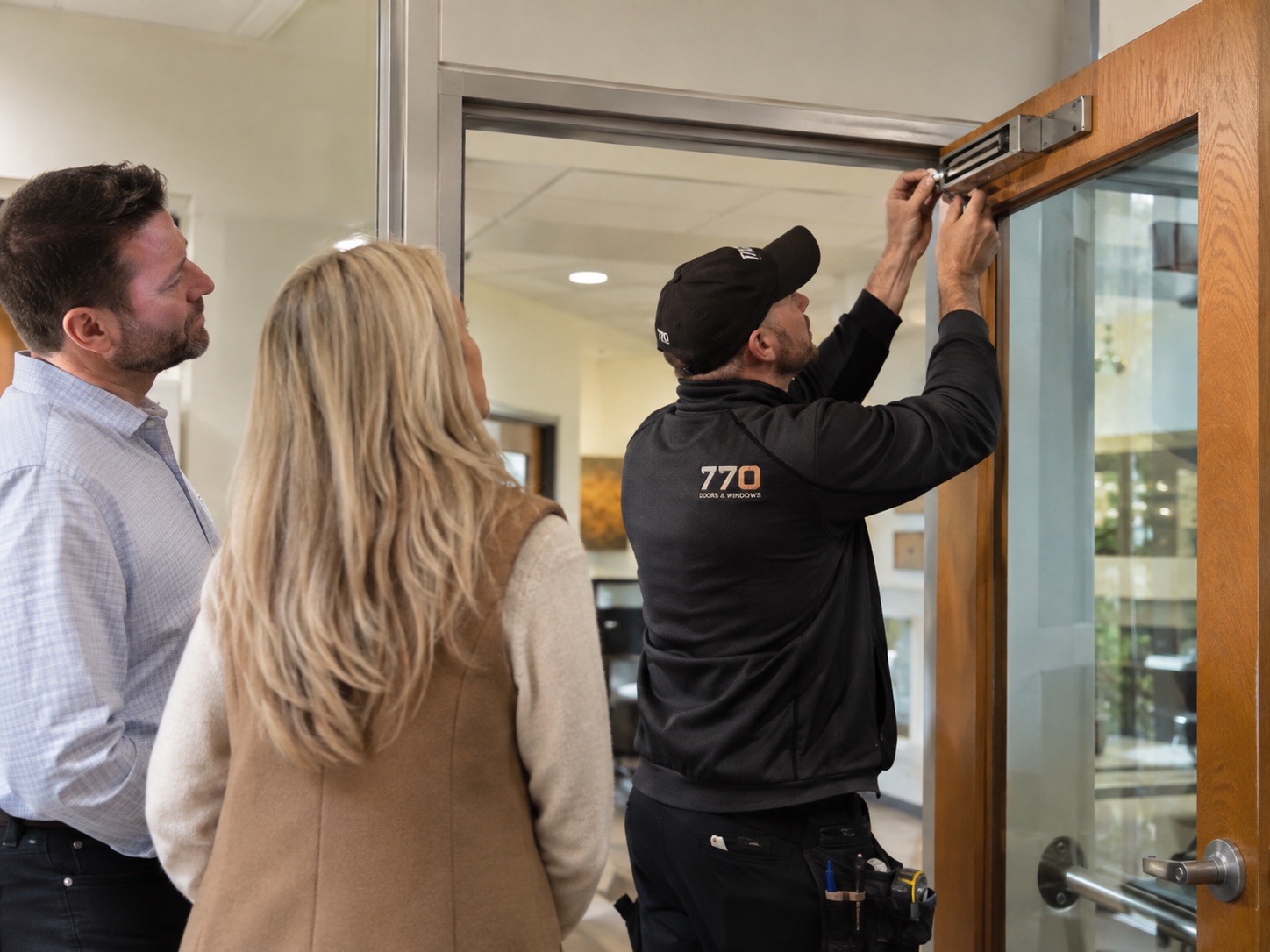
Describe which kind of magnetic-lock failure occurs
Three complaints often arrive under the same description of a bad magnetic lock. The door may have weak holding while it should be secured, release unexpectedly during an otherwise quiet period, or remain difficult to open after an authorized release. Those symptoms lead to different investigations. Weak holding raises questions about contact, mounting, and electrical conditions. Unexpected release requires separating an intended command from an interruption. Delayed opening requires establishing what actually remains engaged. Describe the observed behavior first, including whether the door had fully closed beforehand. A vague report that the magnet sometimes fails leaves the technician to reconstruct these basic distinctions.
Do not test holding strength by yanking the door, using leverage, or striking the hardware. A loose mounting or damaged glass opening can make improvised force testing dangerous and uninformative. Observe normal operation from a safe position and report visible movement, unusual noises, or an obvious failure to secure. If hardware appears loose enough to fall, or ordinary exit no longer works, management should address that immediate condition through its urgent service arrangements. Diagnostic curiosity should not require occupants to keep using a suspect opening while someone tries to recreate a dramatic failure.
Identify the lock and the complete release arrangement
A conventional direct-pull electromagnetic lock holds an armature plate against an energized magnet. Other magnetic locking designs use different geometry or additional features, so the exact model matters. Record identification from existing equipment documents or an accessible label without removing a cover. The technician should establish the matching armature, mounting arrangement, supply requirements, and installed control options. Two units that look similar may not share adjustment methods or operating behavior. A repair proposal based only on the visible length of the magnet can overlook the features and accessories on which the entrance's intended operation depends.
Identify every intended release path as part of the survey: authorized entry, ordinary departure, staff controls, and any emergency or other integrated functions actually present. For a conventional electromagnetic lock, removing its energizing power removes its active magnetic holding, but that fact does not describe the whole doorway. Another locking device, a special operating mode, or mechanical interference can affect passage. Exit behavior and power-loss response must be assessed for the actual design. The service scope should therefore cover the opening and its interfaces, rather than assuming that a replacement magnet alone establishes correct release in every required situation.
Examine how the two faces meet at closure
Magnetic attraction is not a substitute for proper physical contact. Allegion's pull-strength guidance emphasizes that the intended armature should seat flush against the lock face; attraction to a small metal tool does not establish the installed lock's holding performance. For the owner, the useful observation is whether ordinary closing consistently brings the plate to the same seated position. An entrance that stops just short or meets unevenly deserves a door-and-mounting assessment. A larger holding-force label on a replacement does not correct an opening that cannot bring its mating components together as the manufacturer intends.
Watch the final part of normal closing without putting fingers near the mating surfaces. Does the leaf settle, bounce, twist, or require someone to finish the movement? A change in door alignment, a displaced stop, or a closer problem may affect the final position. Note whether the symptom follows work on the hinges, frame, weather seals, or closer. These associations tell the technician where to inspect, but they do not establish which component needs adjustment. The assessment should explain why the two faces fail to meet consistently and how the proposed correction restores that relationship through ordinary use.
Separate required armature movement from loose mounting
The armature mounting can include controlled movement so the plate aligns with the magnet. The FSH FEM6600 instructions specifically require their armature plate to remain movable for alignment. That product-specific detail illustrates why indiscriminately tightening every visible part can worsen holding rather than improve it. At the same time, designed movement is not permission for loose attachment to the door. The installer must distinguish the plate's intended movement from a fastener, bracket, or mounting substrate that is failing. An owner should not decide which is which by turning a screw until the rattle disappears.
Ask the technician to identify the correct mounting hardware and verify its condition against the installed model's instructions. Missing washers, substitute fasteners, damaged attachment points, or an unsuitable bracket require a defined correction. Glass doors and narrow frames need particular attention to their actual mounting arrangement, without assuming that one bracket kit fits every opening. The repair record should distinguish restoring an intended assembly from compensating for a distorted frame. If the substrate cannot support a secure installation, replacing only the magnet may leave the most important defect untouched and conceal it behind newly installed equipment.
Inspect surface condition after painting or cleaning
An apparently clean renovation can change the surfaces that need to meet. Paint, adhesive residue, debris, or visible corrosion on a mating face gives the technician a specific condition to assess. The FSH instructions require clean contact surfaces and warn against coatings that interfere with operation. Do not extrapolate a cleaner or treatment from one product to another. The owner can report when painting, decorating, or intensive cleaning occurred and provide a clear photograph of visible contamination. That history may explain why an entrance that worked before the project now behaves differently despite unchanged access permissions.
Avoid sanding, grinding, oiling, or spraying the lock in an attempt to restore attraction. Removing a protective finish or introducing residue can create additional problems and make later assessment harder. The service provider should choose a manufacturer-compatible treatment, then determine whether damage remains that makes replacement appropriate. If surface work corrects the symptom, include instructions for future cleaners and decorators in the handover. Those instructions should identify the components that need protection and the approved maintenance method. Preventing a recurrence is more useful than simply describing the repair as cleaning without explaining what caused the contamination.
Measure electrical performance in the condition that fails
A power indicator or a reading at the supply enclosure does not establish what the lock receives during the complaint. A qualified technician should compare the electrical conditions at the relevant parts of the circuit with the lock's specified requirements while reproducing normal operation. Securitron's M680E instructions, for example, distinguish average consumption from maximum demand and direct supply sizing around the maximum. Those figures and requirements belong to that series. They illustrate why a system assessment should consider the actual equipment and operating load rather than assume that a familiar power-supply label proves adequate performance.
Tell the provider whether releases coincide with another door operating, a building equipment cycle, or a change between normal and backup power. Such patterns help select a meaningful measurement period; they do not prove that the other equipment is responsible. A marginal connection or a supply problem may be intermittent and absent during a quick static check. Owners should not open energized enclosures or move conductors to provoke the fault. Request a report describing the condition measured, the model requirement used for comparison, and whether the original symptom occurred during the test. That is more actionable than 'power looks good.'
Trace an unexpected release to a command or interruption
When a magnet releases without an obvious card presentation, first ask whether another authorized control requested it. The installation may include an intercom, request-to-exit device, scheduled state, staff command, or integrated release function. Which ones exist and how they interact must be documented for that entrance. Review the event history around the occurrence and compare it with the lock's observed behavior. A release can be unexpected to the observer yet intentional according to the configured sequence. Conversely, an electrical interruption may leave no ordinary access-granted event, so absence of a grant does not automatically identify the failed component.
The technician should determine whether the lock was being instructed to release or lost its required energization for another reason. This is a diagnostic distinction, not an invitation to disconnect release devices until the door stays locked. Disabling a necessary function can hide the complaint while creating a more serious operating problem. If a sensor or interface is issuing unintended commands, the repair must preserve its intended purpose. Ask for the triggering condition, the evidence connecting it to the release, and verification after correction. A stable locked condition means little unless authorized and required release paths still work correctly.
Investigate hesitation after an authorized release
If a user receives authorization but the door hesitates, distinguish delayed control action from continued physical resistance. The technician needs to establish when the release was requested, when the lock's electrical state changed, and when the leaf became free to move. The sound of a relay elsewhere is not enough. A separate mechanical latch, a dragging door, or a feature of the installed lock can affect the observed result. The user can describe whether the resistance feels consistent or whether the door suddenly becomes free after a pause, but should not try to overcome it with repeated force.
Do not diagnose every hesitation as residual magnetism or cure it by altering the armature assembly. The professional assessment should use the model's documented release behavior and examine any relevant local timing or interface functions. If a specific operating mode intentionally delays release, its presence and appropriateness need to be established for the actual installation by the responsible provider. It should not be assumed from the symptom. Acceptance must show that routine entry and departure match the agreed design without requiring users to develop a special pulling technique. A door that works only for a technician who knows its quirks remains unresolved.
Use monitoring signals for the question they answer
Some magnetic locks offer separate door-position and magnetic-bond monitoring. Securitron documents such options within its M680E series, but a particular installed unit may not include or connect every available feature. Establish what is present before interpreting an indicator. A position signal can help show that the leaf reached its closed location; a bond-related signal addresses a different aspect of the lock's condition. The technician should correlate the reported state with the physical opening. A command to lock, an illuminated indicator, and a verified magnetic bond are not automatically three descriptions of the same observation.
Monitoring becomes especially useful when weak holding appears only after certain closure cycles. Ask whether the suspect cycle produced a different status from a normal one and whether that status reached the management system. A local indicator may be visible to the technician but unavailable to remote staff. If the repair includes adding or restoring monitoring, specify how an abnormal condition will be presented and who will respond. Avoid accepting a new dashboard label as proof of improved holding. The mechanical and electrical repair still needs verification; monitoring should make its condition more understandable, not replace that work.
Choose correction or replacement from the findings
A repair proposal should connect each recommended action to an observed defect. Restoring correct door alignment addresses a different problem from replacing a damaged coil assembly, correcting an electrical fault, or renewing an unsuitable mounting. Ask which existing parts remain serviceable and what evidence supports replacement of the others. A higher nominal holding force is not a complete answer to weak performance. The frame, mounting, contact geometry, power requirements, and intended release arrangement all remain part of the selection. The replacement should be evaluated as a component within that opening, not purchased solely because its advertised strength exceeds the old unit's.
Consider maintainability as well as immediate operation. A supported replacement with available documentation and appropriate accessories may be easier to service than a worn assembly assembled from uncertain parts. On the other hand, replacing intact equipment without correcting a door-position problem can reproduce the same complaint. Request the proposed model and accessory arrangement before work begins, together with the reason it suits the installed conditions. Any change affecting the entrance's release design requires qualified assessment of that complete arrangement. The owner should receive a clear explanation of resulting behavior rather than an unsupported assertion that a new lock makes the doorway compliant.
A hypothetical weakness after a decorating project
Imagine a hypothetical storefront whose magnetic lock seems weaker after the door and frame are repainted. The access system still records ordinary operation, and staff initially request a stronger magnet. During assessment, the technician observes a thin coating on part of a mating surface and compares closure before and after the appropriate manufacturer-directed remedy. Electrical checks under the relevant operating condition do not reveal an out-of-specification supply. With the surface condition corrected, the provider verifies the installed assembly using the applicable procedure. The finding supports a contact-related cause rather than a need for greater nominal strength.
The manager adds protection of the locking surfaces to the scope of future decorating work and retains photographs of the identified condition. If coating removal had exposed substantial damage, or the result had remained inconsistent, further repair or replacement would have been justified. This fictional example is not a prediction that painting explains every weak magnet. It demonstrates how recent work can produce a testable hypothesis and how evidence should determine the next step. The useful outcome includes a documented cause, confirmed operation, and a maintenance instruction that prevents the same avoidable condition from returning during the next project.
Accept the opening through holding and release checks
Ask the provider to verify the assembled lock using a method appropriate to the manufacturer's instructions and the installed door. Owners should not attempt a rated-force pull test. Observe repeated normal closures, authorized entry, and ordinary departure, with attention to the exact condition that originally failed. Confirm that the leaf returns to the intended position without a special shove and that any monitoring reflects the verified state. Testing integrated emergency or power-related functions belongs in a coordinated professional procedure appropriate to the actual system, with affected parties aware and the opening restored to normal operation afterward.
The handover should identify the corrected defect, parts or settings changed, and checks completed. Record any unresolved condition that could not be reproduced, such as a particular power transition or intermittent release during a busy period. Establish a maintenance approach suited to usage and manufacturer guidance, including inspection after door adjustments, surface work, or impact damage. Staff can help by reporting changed closure behavior and keeping surrounding travel clear. They should not compensate for developing faults by pulling harder or making undocumented adjustments. A dependable repair leaves the door's normal behavior understandable to the people who use and manage it.